
The Recipes My Grandmother Carried
Savitri Mirchandani, 1922 to 2026: what she took out of Sindh, and how much of it is on this menu
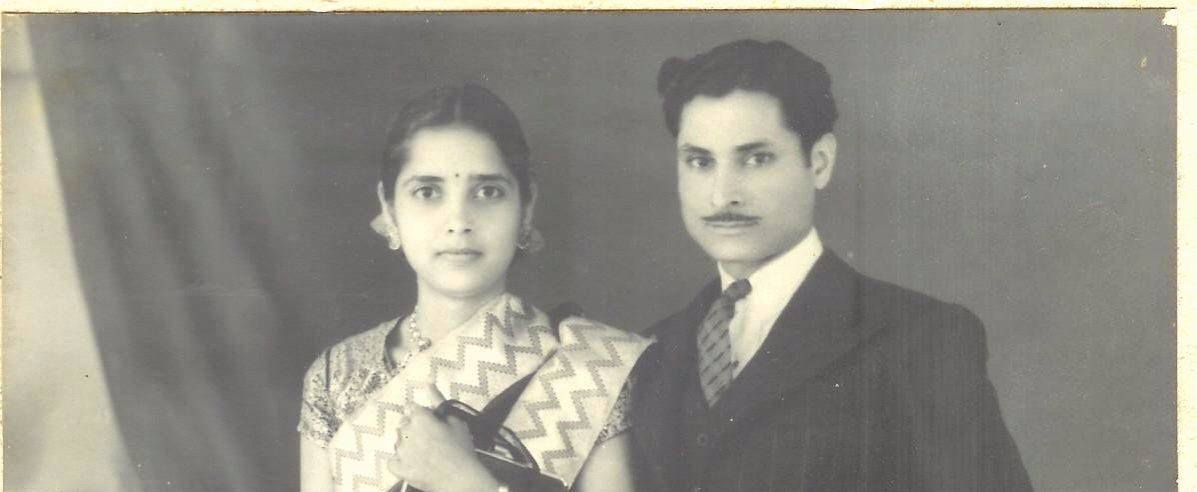
Savitri and Sunderdas Mirchandani on their wedding day, 20 December 1941. Photograph courtesy Maya Mirchandani.
My grandmother, Savitri Mirchandani, left Karachi by ship in 1947 with a suitcase, two small children and a heavy brass mortar and pestle that one of her maids had hidden in the luggage. She died in March, at 103. Her recipes are still on this menu: the lemon daal, the railway chicken, the chilli cheese toast, the vindaloo.
In the family she was Dadima. She was born in 1922 in Hyderabad, Sindh, the sixth of ten children, and learned to cook early, from her mother and her older sisters, in a simple kitchen. She married in 1941 and moved to Karachi, where my father was born in 1945 and my aunt in 1946.
The Night She Left
Sindh was not divided. Punjab and Bengal were cut in half; Sindh went whole to Pakistan, and Sindhi Hindus, for whom language and place tended to come before religion, largely meant to stay. Then the looting started, and the governor of Sindh cancelled every police leave and refused every resignation, whatever the officer’s religion.
My grandfather, Sunderdas Mirchandani, was a lawyer and a police officer, and he was on duty around the clock. So it was my great-grandfather, Rewachand Mirchandani, who came to the house in the early hours with a berth booked on a ship that sailed for Bombay a few hours later. There was no discussion. She argued and was overruled, and she went, with two children under three and one small suitcase, to sisters already settled in Bombay. She was twenty-five.
The decision that emptied her street was taken a long way from it, by men who never had to be on the ship.
The mortar and pestle travelled because the woman who looked after the children put it in the luggage without telling her. Nobody in our family has ever called it that. It is a hamam dasta, heavy brass, and my sister Maya, who cooks with it in Delhi, calls it “the second oldest member of my family.” The oldest was Dadima.
It was the correct thing to pack. Without it she could not have set up a kitchen at the other end, because that is where the cooking starts: whole spices, ground by hand, the same quantities every time.
It was months before he could follow, and months in which nothing was heard from him. His resignation was accepted only after a last assignment: escorting a trainload of Hindus, living, wounded and dead, across the new border at Khokrapar. He reached Bombay after Gandhi was killed.
Maya took her back to Sindh in 2004. Karachi she did not recognise; Hyderabad, where the old havelis still stand in Hirabad with the families’ names cut into the stone, she did. She went round it with a walking stick, as a tourist would. Maya, who was watching, records that our grandmother was “not a sentimental woman.”
A Career That Moved
My grandfather rejoined in the Gujarat cadre, became one of the first Inspectors General of the new Indian Police Service, and ran the Gujarat police force. Then intelligence: he was one of the first senior intelligence officers of the Research and Analysis Wing, and he was in the United States several times between 1968 and 1973, working with counterparts at the CIA while RAW was in its early stages. He died in 1974. My father followed him into RAW.
The postings were Bombay, Ahmedabad, Baroda and Delhi, then Sri Lanka and Egypt, all of which turned up in her cooking: Sindhi first, which she knew better than anyone I have met, then Punjabi, Marathi, Sri Lankan, Egyptian, and after my parents married in 1969, South Indian, because my mother, Vasanti, is South Indian. My mother learned a great many of them in return.
They belonged to the Bombay Gymkhana and the Cricket Club of India, gave cocktail parties for people from the embassies and consulates and the services, and she liked to put out a very large spread. The New Yorker, in its 2014 Bar Tab on this restaurant, records a Hohner accordion ordered from Germany in 1953 for her eight-year-old son, in Egypt. That was the household.
She Never Wrote Anything Down
Ask what her food actually was and the honest answer is short. The base sauces were onion and tomato, cooked from scratch with ginger, garlic and an array of masalas, and the meat or the vegetables went in after that. That is the whole of what I can tell you, because it is the whole of what she ever said.
The rest lived in the hamam dasta and in her hands. She ground raw spices in exact portions, and every time she made a dish it came out tasting the same, and none of it existed on paper. We have spent years writing down what we could.
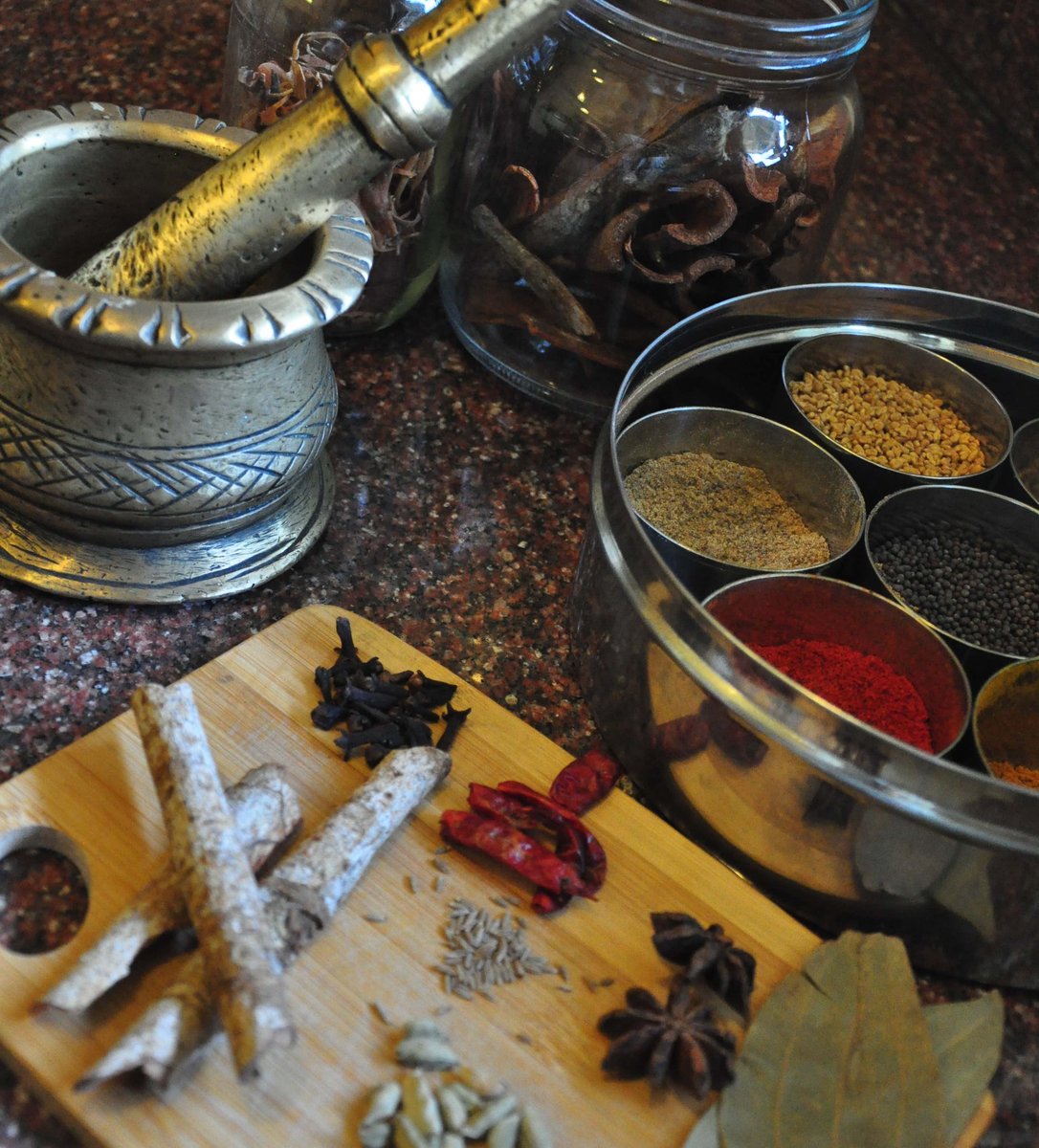
Brass mortar and pestle, whole spices and a masala dabba. Photograph courtesy Maya Mirchandani.
She kept no recipes, so everything of hers we cook was reconstructed by watching, then carried back to her to be corrected. She would taste it and tell us what was wrong with it. A family recipe is not a document. It is an argument that one person wins slowly.
Amritsar, 1978
My grandfather died in 1974 and Dadima came to live with us. In 1978 we were in Amritsar, in a government bungalow with a large kitchen, and that is where my first clear memory of her cooking sits. She was making gajar halwa, and teaching the house cook how she made it, along with a good deal else.
The Sindhi way with it is slow. The Punjabi way is quicker, and we were in Punjab doing it the Sindhi way, which nobody at the time thought worth remarking on. She worked in a cast-iron kadhai she had owned for decades. She started in the morning and it was ready at six. The trick was the rim of the pan: as the milk and sugar caramelised at the edge she scraped it and folded it back in, again and again, until the whole thing was darker and thicker and sweeter than the fast version gets.
The cook and the maid grated the carrots by hand and I ate the gratings raw off the board. It came to the table hot, and Maya and I put vanilla ice cream on it. There were five of us most nights: my mother, my father, Maya, Dadima and me, with people in for tea or dinner most weeks, because she and my mother kept it up.
What Is On The Menu
Mum’s Lemon Daal is hers and my mother’s, two recipes folded into one, which is why the name says Mum. It is the closest thing we serve to untouched. In her later years I would take a container of it to her flat, and she would sit and eat her own cooking made by somebody else, which she enjoyed more than I expected.
The Chilli Cheese Toast I learned from her. The First-Class Railway Chicken is her chicken curry, the way it was made at home. The Roasted Gobi Cauliflower she called gobi ki sabzi. The pork vindaloo is on there because she liked heat, and my tolerance for it is inherited rather than earned. Her Sindhi fish curry runs about once a year, at Diwali.
None of it went on the menu without her. She tasted the dishes, she tested them, and she told us what to fix. We had that for as long as this restaurant has been open.
She was here on the first night in 2013, in a corner with her prayer book while the room worked out what the Drunken Munkey was going to be. She read from it, and blessed the restaurant, and blessed me. She had always said she was confident I would do well. She had her hundredth birthday here, in September 2022, with her family and friends around her. That is the best memory I have of her.
About three years ago her knees gave out and walking became difficult, so I went to her instead, every week, with food from here. Two nights before she died we had dinner together: Paani Puri, her favourite, and chicken tikka masala. She loved it. Of anything that came out of my kitchen she would say the same thing, and it was always enough: “Just like I used to make.”