
Railway Curry, Mess Halls & Gymkhanas
The food of Army cantonments, dining cars and club verandahs — cooked by khansamas, named after nobody, and still on our menu
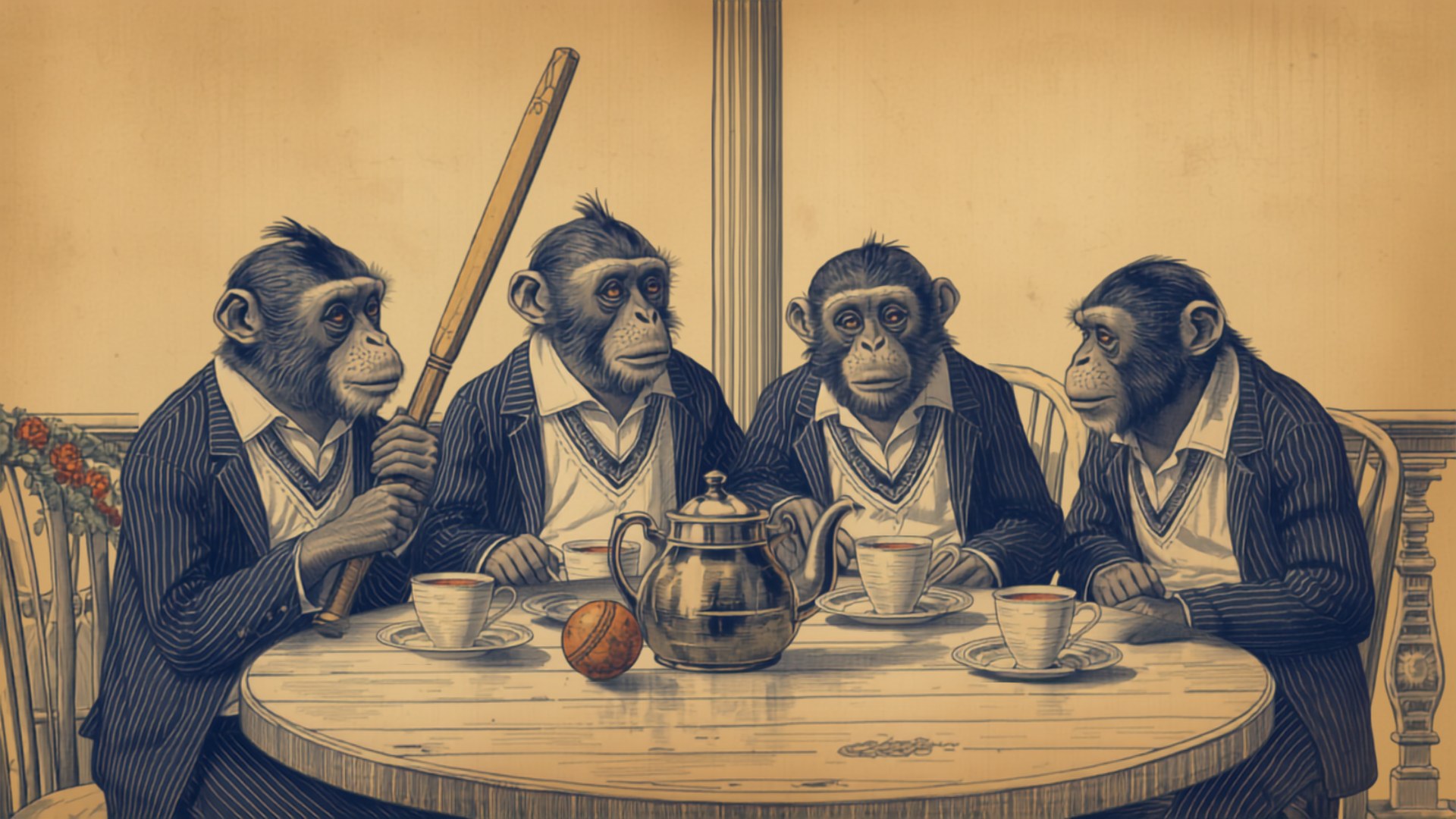
Tea at the pavilion, between innings.
Railway curry began as an insult. The earliest print record we can find is 1969, where it means the please-everybody food of the dining car; the Maharani of Jaipur’s family used it as a jibe, and said it pleased nobody. The first recipe under the name is 1990. The heritage backstory came later.
Old cooking, young name — true of this whole cuisine, which fed people for generations without anybody troubling to name it. It is most of our menu, and has been since 2013.
The Cuisine With No Region
Every other Indian cuisine is named for a place: Punjabi, Bengali, Goan, Chettinad. This one is named for institutions — the mess, the club, the dining car — because the institutions moved and the cooks moved with them. It is the only Indian cooking whose home address is a timetable.
A regiment posted from Peshawar to Poona took its kitchen with it. A refreshment-room cook fed four provinces in an afternoon. What came out is not fusion, and not Anglo-Indian in the pith-helmet sense. It is Indian cooking under strange constraints, by Indians, at volume.
The Man Who Was Not the Cook
Start with the word khansama. It gives the whole thing away.
Hobson-Jobson, the 1886 glossary of Anglo-Indian English, files it under the mangled spelling consumah and hands back the Persian: khānsāmān, “master of the household gear.” That was a Mughal court title. The Mīr Sāmān ran the imperial household’s stores, and François Bernier, in the 1660s, described the office as Grand Chamberlain. He was not the cook, either. The cook was the bawarchi.
What the khansama did, J. H. Stocqueler set out in 1854: he “markets, prepares the pastry and the made dishes, makes preserves, superintends the whole kitchen arrangement, and in general leaves nothing to the cook but the actual cooking.” He ran the place. Forty years on, Steel and Gardiner’s household manual — the standard text for British women in India — listed his wage in its servant table and annotated the entry: A useless servant. The gloss survived three editions.
Ball House
Gymkhana is not an old word, and it is not strictly a real one. Hobson-Jobson calls it factitious — invented — coined in the Bombay Presidency out of gend-khana, “ball house,” the Hindustani name for a racket court, then bent toward the Greek gymnasium by English ears. The glossary traces the first use to Roorkee in 1861.
Bombay Gymkhana was established on 19 June 1875, and its own records give the entry requirement as “a recognised social status.” The Parsi philanthropist Cowasjee Jehangir gave a thousand rupees to furnish the 1876 pavilion and could not walk into it. So Indians built their own: Parsee Gymkhana in the 1880s, the first in Bombay raised on communal lines; Islam Gymkhana on land granted in 1890; the Hindu Gymkhana ground in May 1894. All three sat on the sea front, and they supplied the sides for the Bombay tournament until Gandhi condemned it in 1940 and it was abolished in January 1946.
Those clubs had kitchens, and the kitchens are the part nobody writes about. Curry sat on the ordinary club dinner card as a matter of course, and vanished from the ceremonial one — a Byculla Club banquet menu of the period runs green turtle to bombe glacée without a single curry. Mulligatawny shows why that is funny. The Madras Club has long claimed to have invented the soup. It is milagu tannir, Tamil for pepper water, and it had fed Madras for centuries. The invention consisted of writing it on a card.
The Dining Car
Indian Railways fed people before it fed them moving. Refreshment rooms came first, marked R beside the station name — Murray’s handbook was printing that code by 1892. You ordered ahead, the guard wired the station down the line free of charge, and the meal was waiting when you stepped off. The 1900 Illustrated Guide to the South Indian Railway prints two tariffs: wire six hours ahead and breakfast cost less than if you turned up.
Restaurant cars followed. By 1911 Murray’s Handbook had them on most express mail trains, the catering contracted out in near-monopolies — Spencer & Co. of Madras, and G. F. Kellner & Co. on the East Indian until Spencer’s bought them in 1929.
The codes tell you how the service was ranked. R meant a refreshment room. RC meant the train carried a restaurant car. The Railway Board’s annual reports cover the refreshment rooms and the dining cars, not the letters. RHM, in one railwayman’s memoir of the 1930s and 1940s timetables, meant the station also fed Hindus, usually vegetarian, and Mohammedans, usually halal — food, and nowhere to sit down.
That structure is what the name was mocking. The Maharani of Jaipur described railway curry as food “designed to offend no palate” — no beef for Hindus, no pork for Muslims, so lamb or chicken — and therefore, she wrote, it “pleased nobody.”
Railway curry’s sourness has a myth attached: vinegar carried the dish through two days without refrigeration. It is wrong twice. Vinegar at curry strength preserves nothing, and refrigeration was never absent — the railways ran on ice, advertised in the 1900 guide and described in 1934 as unlimited, replenished at stations with refrigerating plant.
Ours is the First-Class Railway Chicken, and it is mild. That is the same design read kindly: a dish that offends no palate is a dish a whole carriage can eat, young and old, and anyone who wants fire takes it in small bites of green chilli alongside. We are not claiming a recipe lifted out of a Raj dining car. We cook in the line those kitchens ran, under a name that started life as a complaint.
Bada Khana
The mess is the third institution, and the one this restaurant walked out of.
An Indian Army officers’ mess is a formal room — dinner nights, set courses, a mess committee with views on seating. The tradition everybody remembers is bada khana, the grand feast on a regiment’s raising day, where officers, JCOs and jawans eat the same food off the same table. One instruction: feed everybody, properly, at once.
Arun and I both grew up in Army families, and the best meals of that childhood were mess-hall meals. That is not an origin story bolted on; it describes how the menu is organised. It is also why a hot meal goes out of this kitchen at ten every night to anyone who needs one.
Why the Menu Reads Like This
Once the three institutions are visible, the menu stops looking eclectic.
The biryani is sealed under dough and baked, a mess-kitchen answer to feeding thirty from one pot. The Lamb Shank Rogan Josh braises all afternoon, because a braise is what you cook when you cannot predict the hour your people arrive. Mum’s Lemon Daal is the part of an inheritance nobody had to write down. A Garden Club Vegetable Korma and a Sticky Toffee Pudding sit on an Indian menu without apology: club kitchens cooked both.
The House Paanch arrives in a bowl that pours twelve glasses, because punch was a mess and club drink long before it was a cocktail, and a bowl is a social arrangement.
And the Cricket Ball
The Dark Chocolate Cricket Ball is warm rum cake under crème anglaise. In construction that is tipsy pudding: sponge soaked in rum with custard over it, the dessert served in Indian regimental officers’ messes for generations and known to every cadet through the National Defence Academy. We shaped ours like a cricket ball and stopped explaining.
The joke has an address. Cricket is the only game whose laws stop play for tea — Law 11 schedules the interval — so pavilion tea is part of the sport, not a break from it. Gymkhana pavilions cooked those intervals for a century.
One of them cooked a Test match. The first Test played on Indian soil was at Bombay Gymkhana, 15 to 18 December 1933, India against England, C. K. Nayudu against Douglas Jardine, stands run up for a crowd reported at around 50,000. England won by nine wickets. In the second innings Lala Amarnath, on debut, made 118 — the first Test century by an Indian — on the ground of a club that would not have had him as a member.
That is the whole cuisine compressed into one afternoon: an Indian making a hundred on a lawn he could not have joined, and Indian cooks in the pavilion behind him putting the tea on. We named a dessert after it, and it goes out on every private dinner we cook.
What is railway curry?
Railway curry began as an insult. The earliest print record we can find is 1969, where it means the deliberately inoffensive food of the dining car — no beef for Hindus, no pork for Muslims, so lamb or chicken — which the Maharani of Jaipur’s family said pleased nobody. The first recipe under the name is Jennifer Brennan’s, in 1990; the exact phrase “railway mutton curry” turns up in 2006. Ours is the First-Class Railway Chicken, and it is mild — green chillies alongside for anyone who wants heat.
What is a gymkhana?
A gymkhana is an Indian sports and social club. The word was coined in the Bombay Presidency from gend-khana, “ball house” — the Hindustani name for a racket court — then bent toward the Greek gymnasium by English ears; Hobson-Jobson, the 1886 glossary of Anglo-Indian English, calls it a factitious word and traces the first use to Roorkee in 1861. Bombay Gymkhana, established in 1875, set its entry requirement as “a recognised social status,” so Indians founded their own along the sea front: Parsee Gymkhana in the 1880s, Islam Gymkhana on land granted in 1890, the Hindu Gymkhana ground in 1894.
What is bada khana?
Bada khana is the grand feast held on an Indian Army regiment’s raising day, where officers, JCOs and jawans eat the same food off the same table. It is cooking built around a single instruction: feed everybody, properly, at once. The Drunken Munkey’s founders both grew up in Army families, which is why this menu is organised the way it is.
Why is the dessert shaped like a cricket ball?
Because of what is inside it. The Dark Chocolate Cricket Ball is warm rum cake under crème anglaise, which in construction is tipsy pudding — rum-soaked sponge with custard over it, the dessert served in Indian regimental officers’ messes for generations. The shape is a nod to the gymkhana clubs, whose pavilions cooked the tea intervals. Cricket is the only game whose laws schedule a break for tea.
What is the cuisine of the Indian Army mess halls called?
It does not have a name, which is the point. Every other Indian cuisine is named for a place — Punjabi, Bengali, Goan, Chettinad — but the cooking of the Army messes, the gymkhana clubs and the railway dining cars is named for institutions instead, because the institutions moved and the cooks moved with them. It is often filed under “Anglo-Indian,” which credits the wrong people. The cooks were Indian.