
Why Punch Is Called Punch
On paanch, arrack, and the arithmetic every cocktail is still working from
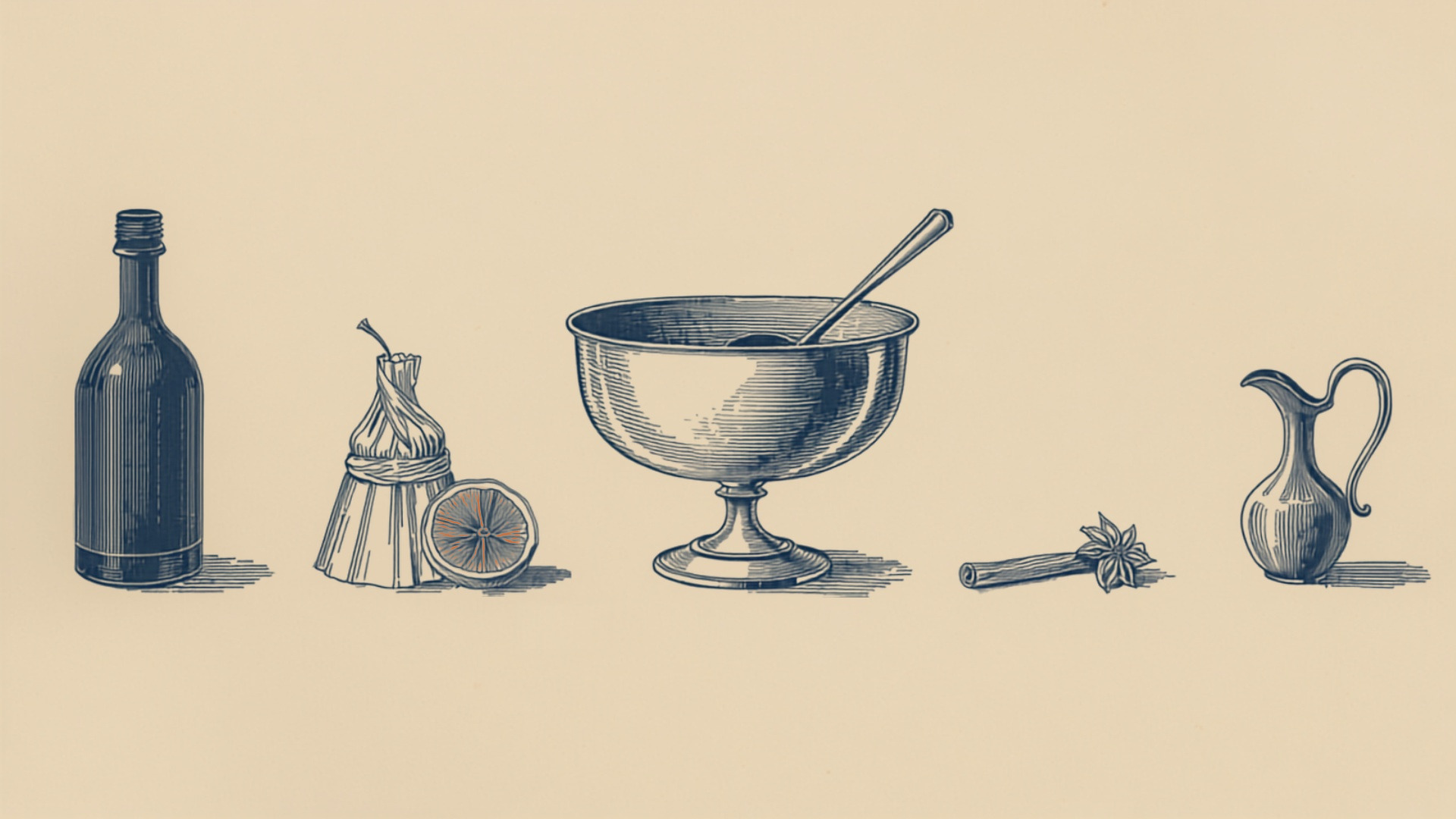
The five parts, not yet one bowl.
Punch almost certainly takes its name from paanch, the Hindi and Marathi word for five, counting its five parts: spirit, sugar, citrus, water and spice. English sailors met the drink in seventeenth-century India and carried the bowl home. It is the leading account of the word, and it is not quite settled.
The First Time Anybody Wrote It Down
The word surfaces in 1632, on the Coromandel coast. Robert Adams, lieutenant of the East India Company fort at Armagon, writes to Thomas Colley at Petapoli and adds the line that made the letter famous: “and drincke punch by no allowanc.”
That is the whole of it. Adams does not explain the word or say what goes in it. He does not think it needs introducing, which is the useful part: by 1632 punch was ordinary enough to write without a gloss.
The first actual description arrives six years later. Johan Albrecht von Mandelslo reached Surat in April 1638, and his account gives a drink of aqua vitae, citron juice, sugar and rose water. Count them. Four.
The One Man Who Said Five
The five-ingredient story rests on a single witness. John Fryer, an English physician who travelled in India between 1672 and 1681, published in 1698. On the Konkan coast he found the arrack of Nerule, and wrote that the English there made “that enervating Liquor called Paunch (which is Indostan for Five), from Five Ingredients; as the Physicians name their Composition Diapente; or from four things, Diatessaron.”
Read the end of that sentence again. Fryer offers the four-ingredient reading himself, in the same breath, four decades after the word first appears in the record. Neither Adams in 1632 nor Mandelslo in 1638 mentions five at all.
More on that side of the scale. Peter Mundy, at Surat between 1628 and 1630, before punch is attested anywhere, recorded a drink of arrack, water, sugar and lime juice under the name charebockhra, which the Oxford Companion to Spirits & Cocktails reads as chaar bakhra, four shares. And the Continental spellings of the period, palepunzen, bolleponge, follepons, look less like a Hindi numeral than like somebody mishearing “bowl of punch,” which is what Yule and Burnell concluded in Hobson-Jobson: “this blunder of the compound word.”
David Wondrich, who edits the Oxford Companion, prefers a different root: puncheon, the cask. His words: “I suspect it came more from the barrel than from the Indian word.” He calls it a guess and leaves it there. Worth saying plainly, because he gets cited as having settled the question. He has not.
The Thing Nobody Mentions About Fryer
Here is a piece of evidence we have not seen anyone else use. The objection to Fryer is that he was a passing Englishman guessing at a word he did not know. So turn to his own table of contents, where a chapter sits listed as “Paunch Augy, or the Penance of Five Fires.” That is panch agni, the five-fire austerity, and it has nothing to do with drinking. Fryer knew the numeral. He wrote it paunch.
It does not prove he was right about the drink. It does show he was not ignorant of the word, and it answers the old objection that panch should have entered English as something nearer paunch than punch. It did. English then wore it down.
So: a leading theory with an honest caveat. Hobson-Jobson calls the five-ingredient derivation “the received etymology” and endorses it without quite asserting it. William Foster, editing the Company records in 1910, printed it as plain fact. It is still the mainstream account, very probably right, and resting on one man who hedged. We say all of that, because the flattened version falls over the first time somebody asks for a source.
Arrack, and the People Who Made It
Look at what was in the bowl, because none of that is in dispute. The spirit was arrack, and arrack was never one thing. The term is Arabic, ‘araq, meaning sweat, then the sap drawn off a palm, then any distilled spirit at all.
In Goa and along the Konkan it came from palm sap, made by people who had been making it long before any European wanted a drink. A Portuguese revenue survey of 1554 already grades the product three ways: sura as it runs from the tree, orraqua boiled once, sharab boiled twice or more. That is a mature industry being taxed, not a novelty being discovered.
In Bengal the spirit came from cane molasses and from rice, and John Ovington noted in 1689 that it ran much stronger than Goa’s, and that Europeans used both for punch. In Java, Chinese distillers built the third great punch spirit early in the 1600s, out of rice and molasses, rested in teak, and shipped to Europe by the Dutch before the century was out.
Punch was possible because three Asian distilling traditions were already running at scale. Europeans did not bring the spirit. They brought the ledger, which is why the paper trail reads the way it does.
The Bowl
A punch bowl is a piece of social engineering. A cocktail arrives finished. A punch bowl arrives unfinished, and the table completes it. It suited institutional life, and India’s institutional kitchens are ground we covered in the last edition.
That is why it took. The Company’s own paperwork is thick with punch, because punch is where people went. A list of finable offences drawn up in 1676 for the young men at Masulipatam includes going to punch or rack-houses without leave. In 1688 the widow of a lieutenant killed at Hooghly petitioned to keep a punch-house, to maintain herself. Fining your clerks for going out for punch while licensing a widow to sell it is roughly how empires do arithmetic.
The Return Leg
In London punch became rack punch, and Thackeray hung a plot on a bowl of it at Vauxhall: “That bowl of rack punch was the cause of all this history.”
In India it stayed on the sideboard, and produced the strangest line in the record. In 1831 the French botanist Victor Jacquemont wrote home: “I have taught my khansama to make very light iced punch.”
Read that twice. A Frenchman in India, teaching an Indian household steward to make a drink whose name, whose spirit and whose first written appearance all belong to the subcontinent. Two centuries of travel, and it came back so thoroughly European it had to be explained to the people it came from.
How the Bowl Became a Glass
The word cocktail reaches print unambiguously in 1806, when the editor of the Balance and Columbian Repository at Hudson, New York, answered a reader who had asked what one was. His definition, in substance: spirits of any kind, sugar, water and bitters.
That is punch’s arithmetic with the citrus traded for bitters and the bowl shrunk to one glass. Cocktail is a separate word with its own murky history, and punch did not give it its name. Punch gave it its shape.
Every cocktail is a punch shrunk to one glass. The bowl came first, and its sum is still the sum: something strong, something sweet, something sour, something weak, something spiced. Europe met that arithmetic in India, wrote the name down badly, and has spent four hundred years rearranging the parts.
What We Pour
The House Paanch keeps the count. Five parts: something strong, something sweet, something sour, something weak and something spiced, over a spiced syrup we make here. The strong part is a secret combination of spirits and liqueurs, and Lupe Toxtli, who runs our bar, has no plans to write it down.
It comes by the glass, and in a bowl that pours twelve. The bowl arrives with a ladle and no instructions, which is deliberate. Somebody works out within a minute that they are in charge of it, and has a better evening than everybody else.
The rest of the bar runs on the same logic, and so does every table we lay for a private dinner: fresh juice, frosted crystal, and a bowl in the middle that nobody owns.
Four hundred years, six spellings and one physician who hedged. The best account of the name is still a Hindi numeral, and the best evidence for it is a man who wrote paunch when he meant five. We will take that, and pour the bowl.
Why is punch called punch?
Punch almost certainly takes its name from paanch, the Hindi and Marathi word for five, for the five parts of the drink: spirit, sugar, citrus, water and spice. The word first appears in English in a letter written from India in 1632. The five-ingredient explanation comes from John Fryer, an English physician who travelled in India between 1672 and 1681. It is the leading account, and it is genuinely contested: Fryer offered a four-ingredient alternative in the same sentence, and no earlier source mentions five.
Is punch a Hindi word?
Very probably, by descent, though it is not proven. Hobson-Jobson, the great glossary of Anglo-Indian English, calls the derivation from Persian panj and Hindi and Marathi paanch, all meaning five, “the received etymology.” The rival theory derives punch from puncheon, a cask; David Wondrich, editor-in-chief of the Oxford Companion to Spirits & Cocktails, prefers it, but calls it a guess rather than a finding. There is no knock-down evidence either way.
What were the five ingredients in punch?
Spirit, sugar, citrus, water and spice. In seventeenth-century India the spirit was arrack. The early sources do not agree on the count: the first description of the drink, from Surat in 1638, lists four (aqua vitae, citron juice, sugar and rose water), and a Bombay government order of 1694 specifies three (Goa arrack, sugar and lime water). The five-part formula describes what punch became at least as much as what it started as.
What is arrack?
A category of spirit rather than a single product. The word is Arabic, ‘araq, and in India it covered spirits distilled from palm sap in Goa and the south, and from cane molasses and rice in Bengal. The Batavia arrack that Europe drank in its punch was made in Java by Chinese distillers from rice and molasses. All of it was being made at scale before Europeans began ladling it out of bowls.
What is the Munkey House Paanch?
The Drunken Munkey’s communal punch, built on the five parts: something strong, something sweet, something sour, something weak and something spiced, over a spiced syrup made in house. The strong part is a secret combination of spirits and liqueurs. It is served by the glass, or in a bowl that pours twelve glasses.